
LONGFORM: #NASCARStrong, A 9/11 Retrospective
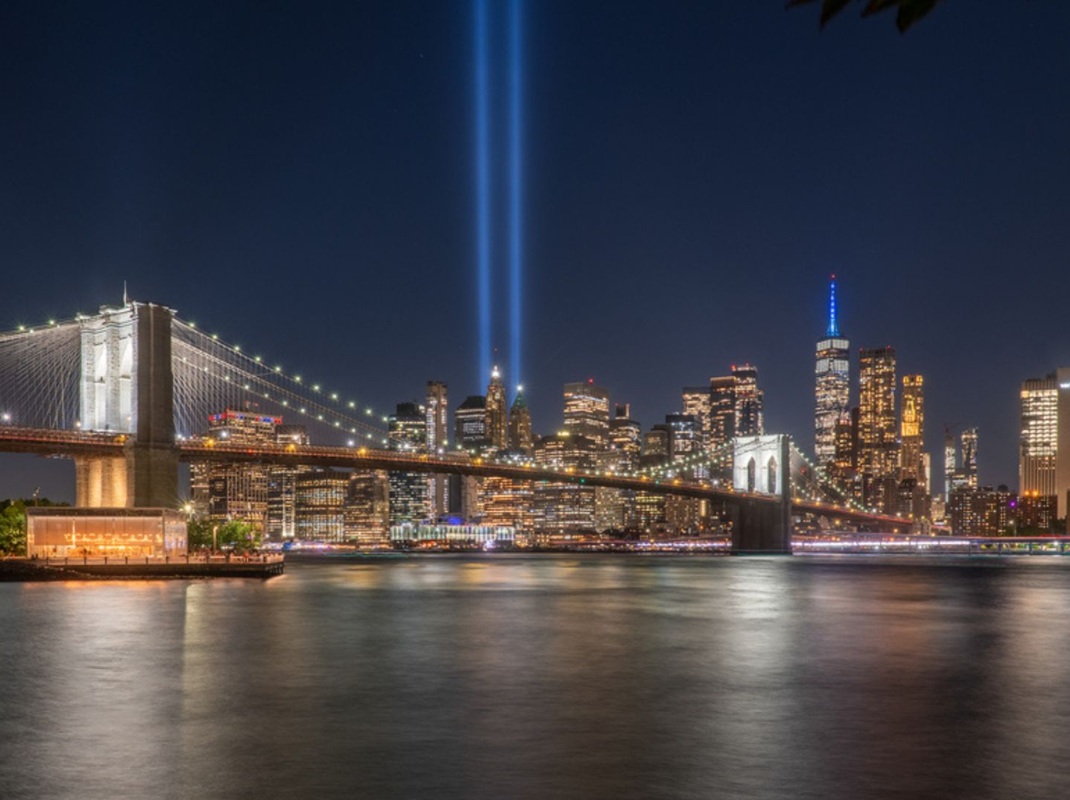
The Tribute in Light honors those lost in the Sept. 11, 2001 terror attacks in New York City. (Photo Courtesy of 9/11 Museum & Memorial)
The following is an edited and updated revival of a retrospective on the Sept. 11, 2001 coordinated terror attacks on the United States and the NASCAR industry's response, emotions, and actions in the days, weeks, and months that followed.
It was first published by the author in 2014 at a prior (now-defunct) motorsports media outlet.
BRISTOL, Tenn. – Twenty-four years ago today, our nation was forever altered by a sequence of four events that forever took away our innocence.
For those who remember, it begs the question: where were you when the nightmare began at 8:46 a.m. Eastern time?
I remember where I was. I was sitting at home; I was home sick from school, and my mom was reaching for the remote to turn the television off when the breaking news hit. The North Tower of the World Trade Center was struck.
It continued at 9:03 a.m., when a second plane struck the South Tower.
Thirty-four minutes later, the Pentagon was struck by a third hijacked plane, and at 10:03 a.m. a fourth plane likely meant for the White House crashed in a Pennsylvania field.
The rest is history, as they say, and the tragic events of that day will be forever remembered by everyone who bore witness to or was affected by the events that took place.
The NASCAR community was as deeply shaken as anyone else in the country, and its drivers, crews and fans were all left wondering — as everyone else was — “Where do we go from here?”
“I remember the morning of Sept. 11 waking up to a phone call, somebody said, ‘You need to turn the news on,’” three-time Cup Series champion and now-NASCAR Hall of Famer Tony Stewart reflected. “I said, “Which news?” They go, “Doesn’t matter.” And you realized really quickly why it didn’t matter, because every channel had it on. But I was laying in bed, and I never got out of bed till six in the evening watching what was happening in disbelief.
“I just could not believe what we were seeing, and that our country had come under attack like that. It’s something that in my lifetime I’d never seen before.”
In unknown or new situations, judgment calls are often made. In NASCAR’s case, the sanctioning body made a quick decision to allow the nation time to heal from the reeling moment it had just experienced.
That choice, ultimately, was to postpone the scheduled Cup Series race at New Hampshire Motor Speedway on Sept. 16 to November and make it the final round of the season.
“We were scheduled to race at Loudon that next weekend. We got together as a group first and foremost,” Brian France, whose father Bill Jr. was the Chairman and CEO of NASCAR in 2001, said of the hours and days following the attacks. “We knew we had to show respect and memorialize those thousands of people who had lost their lives and the sacrifices made by the first responders and all of the law enforcement, fire and safety, military, and emergency personnel that were so closely involved.
“I recall my father recounting tragic events that had taken place over the course of his lifetime, such as Pearl Harbor and the JFK assassination, and how decisions were influenced by those events. We knew in our hearts the best decision was to postpone our race and reschedule it for a later date. The country needed some time to grieve and to heal.”
While NASCAR officials and the France family agreed that the right decision was not to race on the weekend following the World Trade Center tragedy, there were those who were upset with the call and wanted to race.
One of those was Jeff Burton, then a driver for Jack Roush who was getting ready to go to the track where he had led all 300 laps the previous year, and now a 10-year color analyst for NASCAR on NBC.
“I was pissed. I wanted revenge right then and there (for what had happened),” Burton recalled. “And then I wanted us to race. I didn’t want them to cancel the [New Hampshire] race. I wanted to show the world that they couldn’t keep us from doing what we were going to do, although I did understand why people didn’t want to race.”
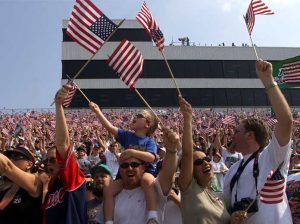
NASCAR fans wave American flags prior to racing at Dover Motor Speedway in 2001. (NASCAR Archives photo)
While there was no racing on Sept. 16, 2001, NASCAR – as the rest of the United States began to – found it in them to start moving again. And they did, on Sept. 23 at Dover International Speedway.
Multiple patriotic tributes took place during pre-race ceremonies, and many drivers sported American-inspired paint schemes. The most notable of those was Ken Schrader, sponsored by M&Ms at the time, who removed every decal from his car and had it completely wrapped in an American flag graphic.
It was a show of support for the U.S. people and a sign from NASCAR that they stood beside their countrymen in the fight for freedom and display of patriotism.
It was also a weekend that, Brian France noted, uplifted those who played a role in it.
“When we went back to racing the following week at Dover, there was a real sense of appreciation leading up to the event,” France said. “We felt proud to have the opportunity to participate in our sport and I really believe the industry came together. We were all one voice in paying tribute to the victims and we celebrated our freedom of being Americans.”
Burton felt it on pit road as well, as did the entire grid that day.
“It was an inspiring weekend [when racing returned at Dover] — the flyover, the National Anthem, the fans, the (chants of) ‘U-S-A’,” Burton explained. “Everything about that afternoon was just very special.”
“The crowd was electrifying. They did a big wave. There were so many ‘U-S-A, U-S-A’ chants. Just reciting that now gives me goose bumps,” said Dover Motorsports President and CEO Denis McGlynn in 2024. “Tanya Tucker sang ‘God Bless America’ and the national anthem and Lee Greenwood sang ‘God Bless the USA.’ There wasn’t a dry eye in the house.”
And ultimately, on a day when NASCAR and the American people needed healing, it happened — for the second time in 2001 courtesy of future Hall of Famer Dale Earnhardt Jr.
Earnhardt, who started on the pole, first took the lead on lap three, and dominated much of the MBNA Cal Ripken Jr. 400, fell back in the field after a slow pit stop and had to rally back.
However, he caught a late caution and ultimately took the lead from Dale Jarrett with 39 laps left, going on to win his second of three Cup Series races that season.
He’d already won the July event at Daytona (Fla.) Int’l Speedway, the first race at that racetrack after his father’s death in the Daytona 500 and another win that allowed healing for the masses through the sport of auto racing.
That September Sunday, Earnhardt won again, then chose to forego a traditional victory burnout for a more subdued celebration featuring a backwards celebration lap with an American flag aloft from his cockpit.
“[I’m] glad I could be the guy to win the race so I could carry the American flag around there. It made me feel good,” he noted. “[There’s] no way to describe that win at the Monster Mile other than emotional.”
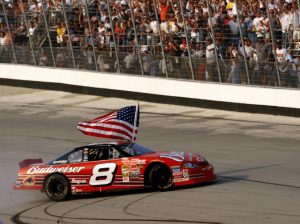
Dale Earnhardt Jr. celebrates his now-iconic NASCAR Cup Series victory at Dover Motor Speedway in September 2001. (Jamie Squire/Allsport via Getty Images photo)
Now 50, Earnhardt doesn’t remember a lot of what happened that day — only the parts that mattered.
“I don’t remember hardly a thing about that race,” Earnhardt said during a 2011 interview on ESPN, forgetting that he led 193 of the 400 laps that day. “I remember that amazing pre-race show and then I remember the celebration after we won. It wasn’t about me at that point. It was about celebrating America. And it was about feeling normal again.
“I remember thinking, OK, we’re back at the track now. We’re all happy again, even if it was just for a few hours. Maybe now it’s OK to smile again, to feel normal again.”
That feeling of normalcy began to grow stronger in the weeks following the Dover race, and ultimately, the season continued and saw Jeff Gordon crowned champion for the fourth time in his Cup Series career when he clinched the crown at Atlanta.
However, there was still one race remaining — the rescheduled race at Loudon.
Coincidentally, Jeff Gordon was also in contention to claim the victory at Loudon, however the Hendrick Motorsports driver would spin out of the lead after a hard battle with Robby Gordon and watch as Robby went on to claim his first (and to this date only) oval victory of his major motorsports career.
Robby Gordon donated all of his winnings to the victims of the 9/11 attacks — another gesture from a NASCAR community which banded together in support of a country that had supported it since 1949.
A special moment for one team allowed for a bright moment to close a shadowy 2001 season. However, a year that was marred by the death of Dale Earnhardt and the tragedy of 9/11 did have an ultimately positive impact.
That year brought the NASCAR community together in a way that, perhaps, no season has quite done to that magnitude ever since.
A feeling that began at Dover began to carry through the rest of the year and has continued ever since those dark days nearly a quarter of a century ago.
McGlynn described it from his perspective in 2011 when reminiscing about the days after the attacks.
“It was the most difficult and yet most satisfying experience of my career,” McGlynn said of the September 2001 Dover race. “There was a feeling that day that I wish we could bottle up. Yes there was sadness and fear, but then excitement and pride, and ultimately relief that we got through the day OK.”
NASCAR and the United States got through the day, then the month, then the year. And slowly, as a community and a country, people began to move forward again.
The years have gone on, but no one has ever forgotten that time in history. And just as we have done each year since 2001, on this day we stand together in remembrance of those lives who were tragically lost — firefighters, rescue workers, police officers, first responders, and all those that went to work that day expecting to come home and never did.
We stand not as one, but together. That was the overwhelming positive feeling that came out of so many negatives on that fateful day.
It was not a day that changed us as much as it showed us who we really were, and what we were capable of being, as a united people and country when standing together as one.
It's a feeling that, on this day, should be remembered and recaptured in looking toward the future.
Today, NASCAR Craftsman Truck Series drivers take the track at Bristol (Tenn.) Motor Speedway in both competition and remembrance – the eighth time a NASCAR national series event has been held on Sept. 11 since the attacks and first time featuring the Truck Series.
It’s an emotional balance that has become commonplace on a day that in 2001 was anything but commonplace.
Moreso, it’s the latest opportunity to reflect, as well as unite in the love of sport – a passion that carried myself and so many others through the darkest time in modern American history.
May the families of the victims find continued comfort, Godspeed to all that we lost, and God bless the U.S.A.
We will always remember.
All opinions expressed are those of the writer and do not necessarily reflect the views of Motorsports Hotspot, Race Face Brand Development, their partners, or other contributors.

Attention Drivers and Race Teams!
Do you need to rev up your brand? At Victory Lane Design, we specialize in one thing, getting you noticed!
It's time to accelerate your brand into the fast lane with Victory Lane Design.
Where Winning Counts!
